Your newborn will grow and change more in their first year of life than during any other time, making it an exciting (and at times anxiety-producing) age, particularly for first-time parents. Being a parent is one of the hardest jobs we’ll ever do, filled with joy, along with stress and anxiety, not only about managing your child’s ups and downs, but most importantly, having the support to manage your own ups and downs that come with the job of being a parent. Although there is no “perfect parenting” manual to guide us, having the knowledge of how to manage our own big emotions together with knowledge about their developmental stages can help.
Within the first thousand days of life, your baby’s brain is growing rapidly, with one million neural connections happening every second. Every baby is different and will grow at their own pace, but during this malleable, plastic first year, your baby will change dramatically in five areas of development: physical (sensory and motor), language, cognitive, emotional, and social skills. Each physical change provides a different and unique perspective on themselves and the world around them.
As research shows and we can see, children are born ready to learn, and optimal learning and development happen within the context of responsive, empathic relationships with trusted, nurturing, supportive adults. From a baby’s first smile, squeal, cry, and scream, they are communicating with you through their first language – emotion. How we respond to these cues and help children develop emotional competencies is dependent on our ability to manage our own emotions, so we can be available to model, guide, and respond empathically and calmly.
Remember, a developing brain overwhelmed by dysregulated emotions cannot learn. Emotional intelligence – our ability to recognize, understand, express, and manage our own emotions and those of others – is the key to dealing with the hurdles and challenges kids and adults face. We aren’t born with these skills, but we are born able to learn. If children are learning from adults who have the necessary support in dealing with their own emotionality, then their child(ren) will be set on the path to healthy brain development, a positive and secure sense of self, strong relationships, and success in learning and life.
Here are some tips and activities that you can use and practice during the first year of your child’s life to help guide you through this amazing, rapidly ever-changing period of your child’s life and yours as a growing parent.

0-3 months
Cognitive Milestones:
- Will turn to gaze at new objects in interest
- Gaze longer at complex objects
Language Milestones:
- Expressive language development – cooing, crying, vocalizing
- Looks, listens, and smiles back at caregiver
Sensory & Motor Milestones:
- Begin to lift head
- Examine hands, try to touch, and grab fingers
- Sensory integration – children start to wiggle their fingers, see their fingers move, and feel them move
Emotional & Social Milestones:
- Sensitive, cooperative interactions with caregivers help infants learn how to manage tension
Activities:
- Peek-a-Boo Emotions: Practice emotional expressions with baby in the mirror to build recognition, expression, and early emotion identification skills
- Fabulous Felt Stories: Use high-contrast colors and cozy felt characters to make storytelling interactive and fun!
3-6 months
Cognitive Milestones:
- Recognizing primary caregiver by sight begins around 5 months; recognizing familiar people by sight, sound, and touch around 6 months
- Can maintain attention for up to 30 seconds (6 months)
Language Milestones:
- Turn-taking conversations (vocalizations from child, responses from adult) begin around 4 months
- Vocal reactions to their environment changing (e.g., a toy being taken away, being held)
- Receptive language development –taking in the sounds and words of others
- Expressive language development – babbling, sound imitations
Sensory & Motor Milestones:
- Lifts head
- Uses all 5 senses to learn
Emotional & Social Milestones:
- Sensitive but firm responses from caregivers help infants manage emotional stress
- Consistency, predictability, and routine set the foundation for secure and positive attachment
- Different emotional reactions to changes in their environment
- Begins to exhibit self-soothing behaviors (e.g., sucking a thumb)
Activities:
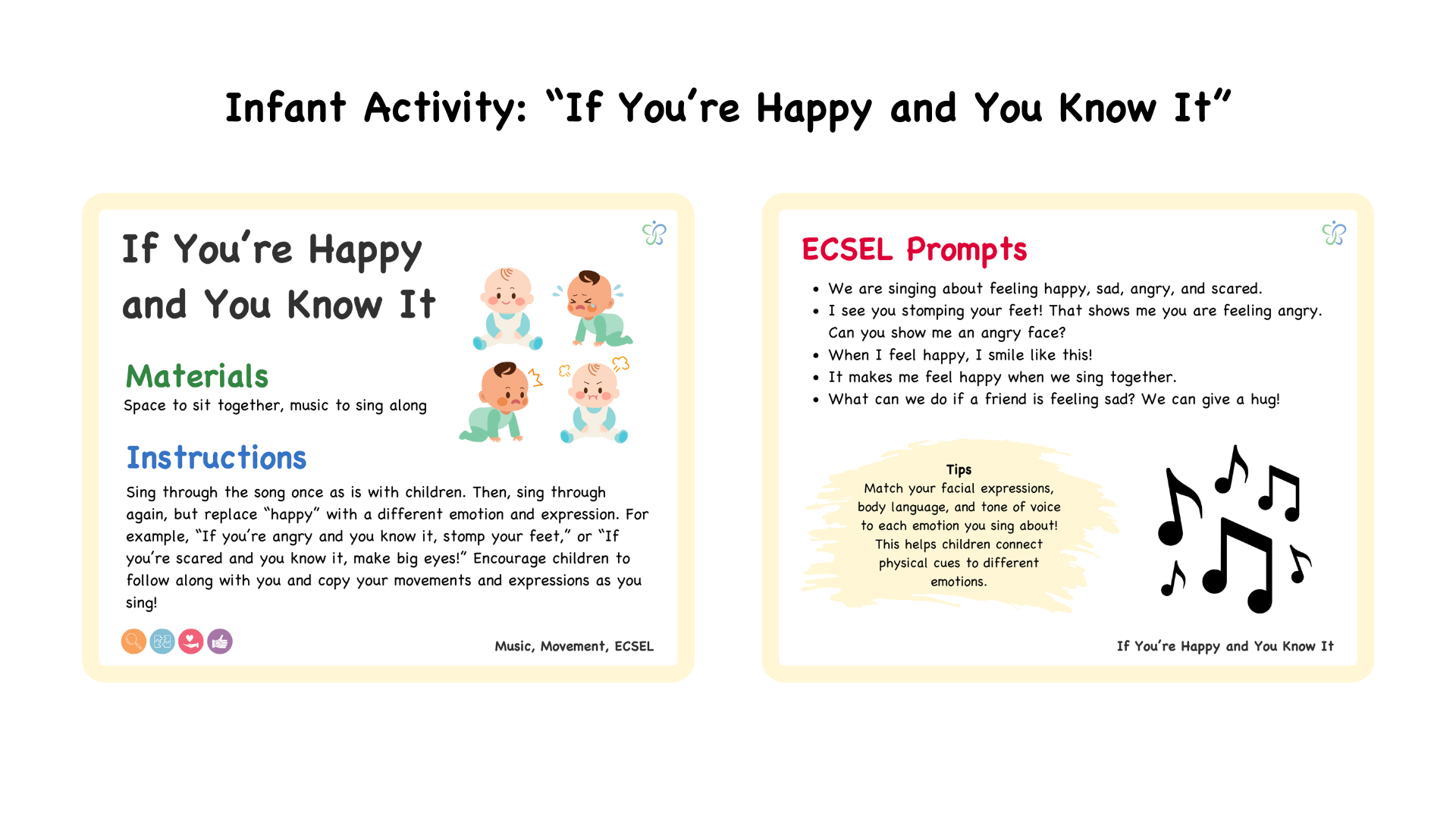
- If You’re Happy and You Know It: The song we all know and love, but with a range of emotional expressions. Singing with baby encourages early language development!
- Pull & Tug Sensory Box: Invite baby to use their growing motor skills to seek and find different items and use their five senses

6-9 months
Cognitive Milestones:
- Observing novel objects and the behaviors of others
- Object permanence – recalls a person or object even when they are not there (starting at 6 months)
- Focuses attention for up to 30+ seconds
Language Milestones:
- Mutual engagement in interactions with others
- Babbling, gesturing
Sensory & Motor Milestones:
- Grabbing for toes when laying down
- Turning/rolling over
- Sitting up and pulling themselves up
Emotional & Social Milestones:
- Attachment relationships are established with a responsive caregiver
- Attachment is regarded as a pivotal event in a person’s emotional development
- Lays the foundation of a child’s security, harbors self-esteem, and builds emotional regulation and self-control skills
- “Stranger danger” – anxiety around unfamiliar people
- Distress upon separation
- Seeks out caregiver for comfort, help, and play
Activities:
- Color Baskets: Strengthen and engage baby’s cognitive skills with this fun sorting activity. Include a variety of different sensory exploration opportunities to make the most out of this activity.
- Texture Art: Exploring our sense of touch can be colorful and fun! Babies can practice using their fingers, hands, and grip to mix colors and make textured prints.
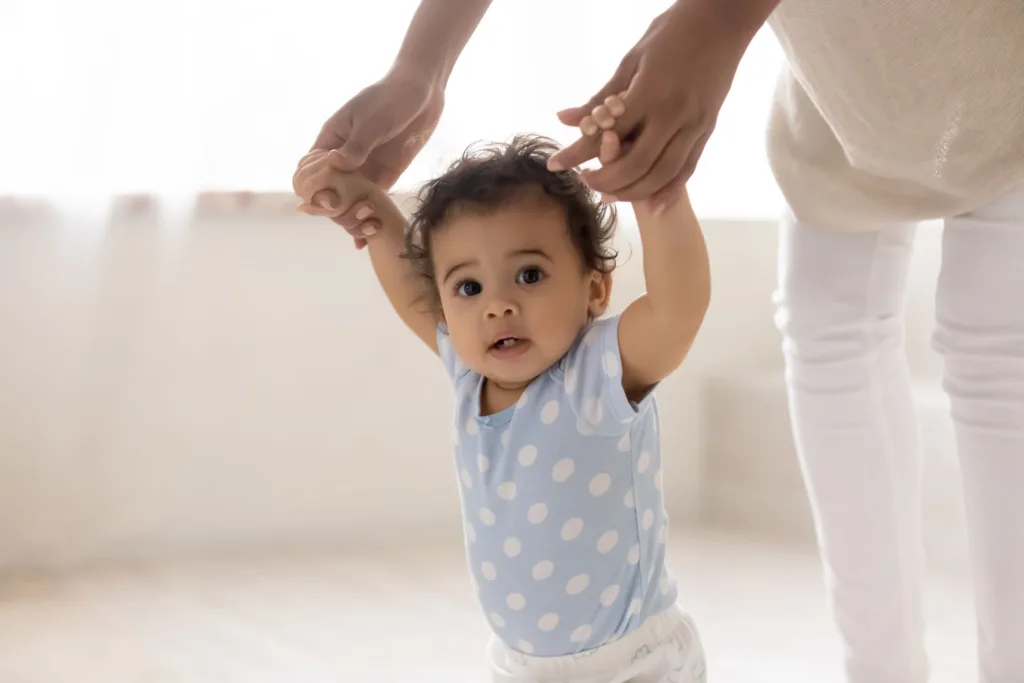
9-12 months
Cognitive Milestones:
- “Discovery” phase – searching drawers, cabinets, and other areas of interest
- Joint attention skills (e.g., following caregiver’s gaze and looking in the same direction) develop around 8 months
- Eventually, children look back at the caregiver after this interaction to show a shared experience
- Attention for 60+ seconds
Language Milestones:
- Continued vocalizations; development of one or two words
- Can use sign language to communicate needs and emotions
Sensory & Motor Milestones:
- Sitting up
- Pulling themselves up
- Crawling
- Cruising and walking
Emotional & Social Milestones:
- Babies are curious and show a variety of different emotions
- Personality starts to shine through
- Smiles when looking at own face in the mirror
Activities:
- Sensational Nature Exploration: Get into the great outdoors and take in the sights, smells, textures, and sounds with your baby.
- Dinosaur Egg Ramp Roll: Roll the dinosaur eggs down the ramp, safely into their nest below! Baby can practice grabbing, rolling, and problem-solving with this movement activity.