
The November 5, 2025 issue of The Economist includes the article, “Universal Child Care Can Harm Children,” which explores the results of various attempts to make early child care accessible to all parents, regardless of income status.
The one aspect of early childhood care that is undebatable is that it is expensive, so much so that The Economist argues that “a household with two working parents and two young children can spend as much on child care as on housing.” The article notes that not providing options for early childhood care can have long-term negative societal impacts.
For years, different experiments and solutions have been implemented to try to provide early childhood care to those who need it most – poor working families, oftentimes mothers, who must choose between staying home to care for their children or finding work to provide for their children. These experiments (all evaluated by research) have yielded vastly different results.
The Perry Elementary School experiment in Ypsilanti, Michigan, followed a small group of low-income children enrolled in a small pre-school program through their K-12 careers and even into adulthood. According to the article, “The scheme had an unambiguous and overwhelmingly positive impact: the kids were more likely to graduate from school and less likely to be arrested or convicted of crime.” In 1997, an attempt to scale and replicate the trial was made by the province of Quebec, Canada. The Quebec trial offered universal early childhood care for $5 a child to any family, regardless of income. Enrollment numbers skyrocketed. However, after following children who participated in the program through their K-12 careers, the results were startlingly bleak – aggressive behaviors, arrests, and poor academic scores were among the findings. Mr. Heckman, the lead researcher and evaluator of the program concluded, “These were warehouses,” he said. “They were fairly impersonal, there wasn’t any real quality. Quality has to be a sine qua non of the whole enterprise.”
The article goes on to provide examples of universal care that has fallen short of the mark and even shown signs of “harm” as in the Quebec experiment. While a case can be made that it can be harmful, I would argue that Mr. Heckman’s conclusion really hit the nail on the head. Universal care, in and of itself, is not the answer. It is the quality of care – the high quality of care – that is more important.
The question is, what does that care look like, and how do you scale it so that all children can benefit from such a program?

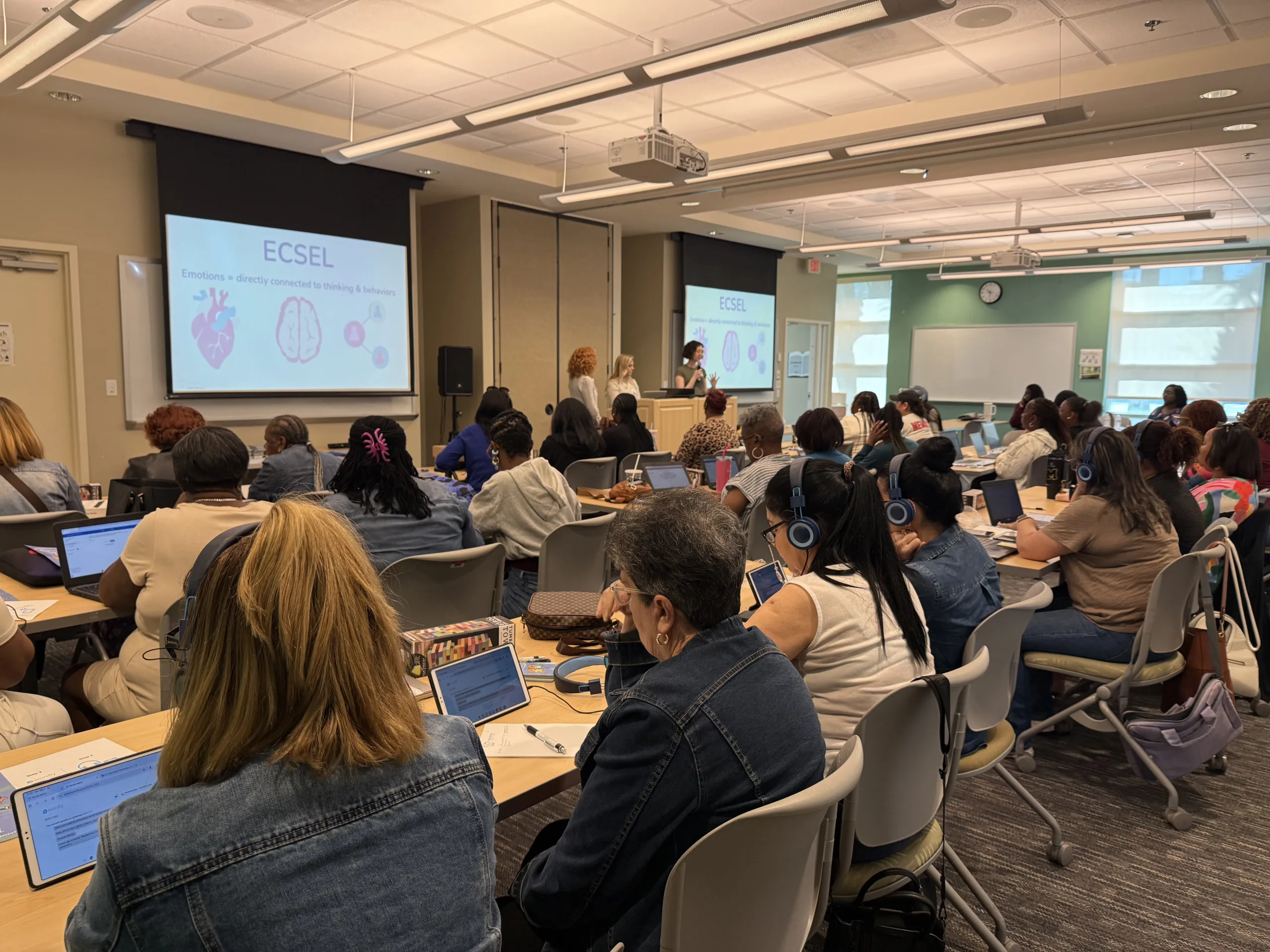
It starts with the educator and/or caregiver. Nurture and responsive relationships are critical, or rather sine qua non, to creating a successful early childhood education program. Fostering emotional intelligence competencies from an early age has lasting benefits for a child’s academic and social development. These emotional competencies must be fostered by an educator or caregiver who not only understands emotional intelligence competencies but also practices them. The ability of the educator/caregiver to model this behavior is step one in the cognitive development of a young child – even from birth.
A program that starts with emotional intelligence teaches even the youngest children to both manage emotions and understand the emotions of others. This enables them to develop and regain control of their thinking, emotions, and most importantly, their behavior.
Less aggressive and dysregulated behavior, and an increased ability to deal with anxiety, stress, and big emotions, lead to well-adjusted, well-rounded children who succeed personally and academically.
For this reason, it’s imperative that we provide the training and support teachers need in helping children to develop the skills of managing and regulating their emotions and understanding those of others, which promote empathetic growth, resilience, critical thinking, effective communication, and academic success.
By equipping children with these skills, we empower them to navigate life’s stresses and challenges, build meaningful relationships, and contribute positively to their communities.
During the holidays, be mindful of the big emotions everyone is feeling, including yourself – the excitement and joy as well as the stress and challenges of family dynamics that can often result in heat-of-the-moment reactions. Take a deep breath, temper the emotion by saying I can do this without needing to explode, shut down, or walk away – the typical fight, flight, freeze responses that can happen in the heat of the moment to us all. And enjoy the holiday being together with family and friends!