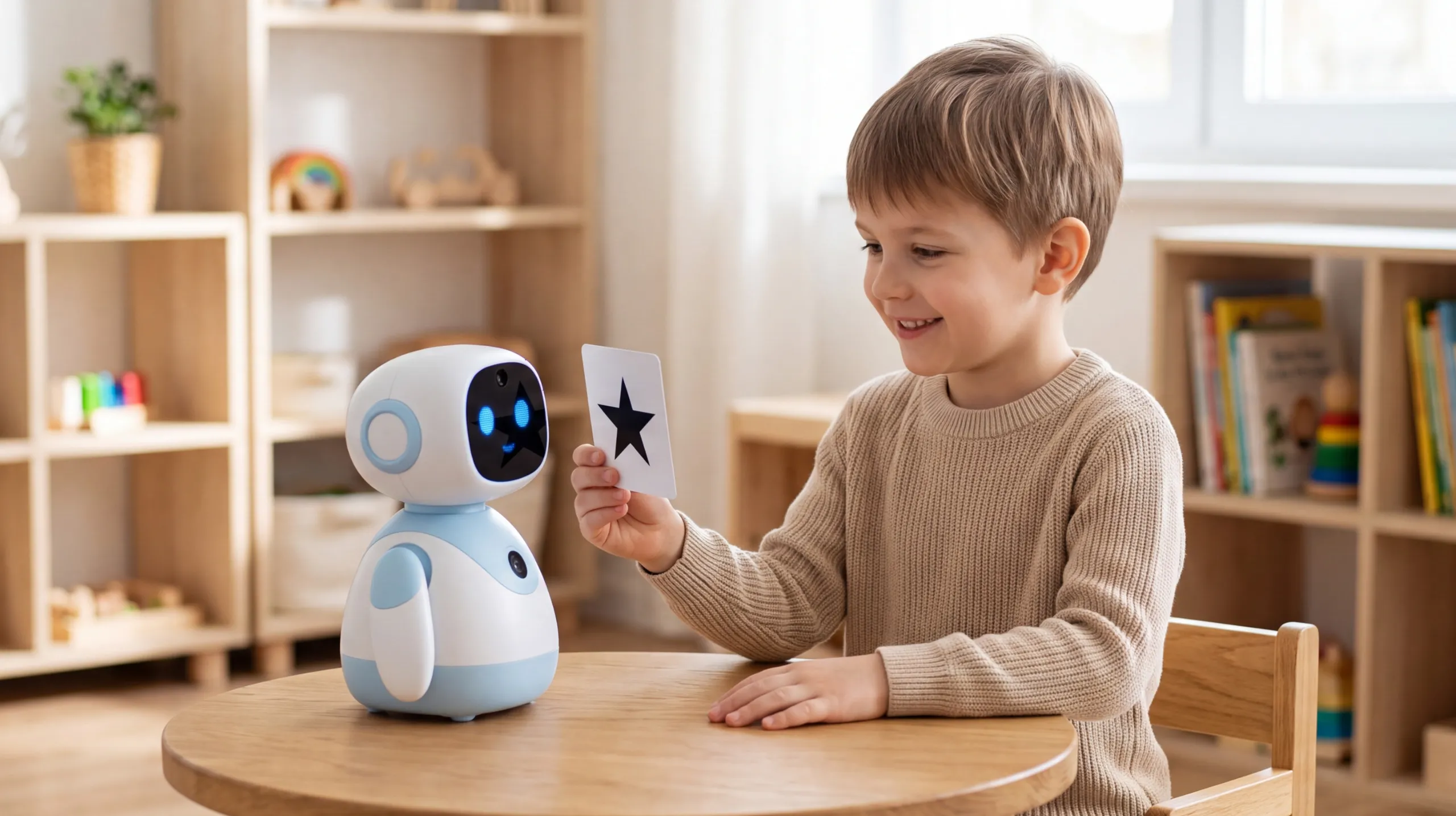
It is bedtime, and a four-year-old who is not ready to be alone yet has stopped asking the speaker on her nightstand why the moon follows the car. Her voice has changed. She is asking it whether monsters are real, and then nervously asks if it can shoo away the monster who’s hiding under her bed. She sounds scared, and she is still talking to the speaker instead of calling a parent back into the room.
It is an ordinary Tuesday in an early childhood classroom, and a cup of juice tips over, a block tower falls, and two children reach for the same truck at the same moment while the teacher in the middle of it all is already running on fumes.
And in a district office across town, a superintendent has a new AI learning platform open on the screen. The demo was impressive, the budget has already cleared, and the contract is sitting on the desk, waiting for a signature before the day is out.
These three scenes belong to different adults, but underneath them runs the same question, and it is the question I would put at the center of every decision we are now making about AI and young children. What is this building in the child, and what might it quietly be replacing?
I have made the developmental case before. I have written about why the first five years decide 90% of brain development, and about why connection must come before any tool. This piece is about the decision that now sits inside those years, because AI has arrived in childhood, and every adult around a young child is deciding, mostly without noticing, what it will be allowed to stand in for.
What EI before AI actually means
EI before AI is a developmental sequence, not a slogan. Emotional intelligence, the capacity to recognize a feeling, understand what is driving it, express it, and regulate it, is the foundation the rest of a child’s learning stands on. A brain occupied by dysregulated emotion cannot reason, problem solve, or take in new instruction, no matter how well designed the tool in front of it happens to be.
Reverse the order and what you get is a substitution. The tool steps into the exact moments that were supposed to build the young child’s development: the struggle, the not knowing, the reaching for another person to help find a way through. That only happens within the context of relationships. That discomfort is where patience gets built, and frustration tolerance, and the ability to sit with a hard feeling long enough to work through it. When a child hands that struggle to a machine, the answer comes back right away, the child feels relieved, and the growing does not happen. It is a little like doing a child’s workout for her and then wondering why she has not gotten any stronger. And the serve and return a young child’s brain is built through, the live exchange with a person genuinely moved by what she just said, is exactly what a machine, however well it personalizes, cannot return.
Older children are already reporting the cost themselves. In the Center for Democracy and Technology’s 2025 survey, about half of students agreed that using AI in class makes them feel less connected to their teacher. That habit, taking the hard feelings to a machine instead of a person, does not begin in adolescence. It starts younger than most of us think.
For parents: curiosity, or a big feeling
The device in your kitchen is not the enemy, and none of this is about taking it away. Here is one simple thing to notice this week. When your child turns to the voice assistant, pay attention to what she is actually bringing it. If she is asking why the sky is blue, or how airplanes stay up, that is curiosity, and the machine can answer all of it. If she is quietly bringing her frustration, her sadness, or her fear to the screen instead of to you, that is a big feeling looking for a person.
When you notice the big feeling, that is the moment to lean in and be the one she brings it to. Name what you see, out loud, in plain words. Stay with her for a moment before you solve anything. A voice assistant can answer a question. It cannot co-regulate, and it cannot be the calm, steady presence your child borrows from when a feeling grows too big to hold alone.
For teachers: the thing underneath everything else
If you have ever thought, I can barely regulate myself, how am I supposed to help a room full of children regulate theirs, that thought is not a flaw. It is honesty, and it deserves a serious answer, because you cannot give a child something you cannot reach within yourself.
The answer is that you do not have to be perfectly regulated. You have to be regulating out loud, where the children can see you. When frustration rises, name it, take the breath in front of them, and if you lose your composure anyway, come back and name that too. That comeback teaches a child that big emotions do not rupture a relationship, they create the opportunity to repair it. This is not one more thing on your plate. It is the thing underneath everything else on the plate, the thing that makes the rest of the day possible.
For school and district leaders: one question before the next contract
Every district leader already knows where the repair-side money goes: intervention teams, behavior plans, therapeutic classrooms, good teachers burning out. Each of those investments is necessary. None of them is upstream enough. The upstream is the earliest years, and the adults standing in them, because that is where regulation is built, or where it is not.
So before the next platform is approved, ask one question before any other, and it is not what the platform promises or what it costs. What is it building in the child, and what might it quietly be replacing? If a tool strengthens a skill a child has already learned to practice independently, it is worth exploring. If it steps into the place where a child was supposed to struggle, reach for an adult, and grow, the bill comes due later, on the repair side, where it is always larger.
Build it early instead, and a meaningful share of what a district now pays to repair in later grades never has to happen at all. As the next budget cycle comes around, I would ask every leader to hold one more question next to the repair lines: how much of what we are about to buy is building the child in front of us, and how much of it is quietly standing in for something we should be building ourselves?
The evidence
This is not a matter of instinct. At Housman Learning we ran a rigorous, peer-reviewed study of young children against a demographically matched comparison group. Within less than a year, the children in the program significantly outperformed the comparison group in emotional competence, self-regulation, executive functioning, and learning. The foundation can be built, it can be measured, and we have measured it.
Whether you are raising a young child, teaching a room of them, or making decisions for a district full of them, the sequence is the same. Build the emotional intelligence first, and much of what we now pay to repair later never has to happen at all. It is far easier to prevent than to repair, and we all know which one our children deserve.
Frequently asked questions
What does EI before AI mean? EI before AI means building a child’s emotional intelligence, the capacity to recognize, understand, express, and regulate feelings, before or alongside any AI in a child’s life, because emotional regulation is the foundation that makes learning with any tool possible in the first place.
Is it harmful for a four-year-old to talk to a voice assistant? The device itself is fine. What matters is what the conversation is replacing: a voice assistant can answer a child’s curiosity all day long, but it cannot co-regulate a child’s big feelings, and that part of development still needs a present adult.
What is co-regulation, and why does it matter in early childhood? Co-regulation is the process of a calm adult helping a young child’s nervous system settle, through voice, touch, and a steady presence, and it is the foundation self-regulation is built on. A child cannot learn to manage her own emotions without first experiencing calm from a trusted adult, over and over, until she can take it in, make it her own, and eventually do it herself.
Why do calming scripts fail during a real meltdown? Scripts fail during a real meltdown because a script is a cognitive tool built for a calm brain, and a meltdown is an emotional state in which the child’s thinking brain, and often the adult’s, has gone offline. A child in distress is not asking for the right words. He is asking for a regulated adult.
Is emotional intelligence really teachable, or is it an innate trait? Emotional intelligence is teachable and researchable, not an innate trait or a soft skill. It can be built deliberately in young children through responsive relationships with trained adults, with outcomes that hold up under peer-reviewed study.
What question should a school ask before adopting an AI learning platform? A school should ask what the platform is building in the child and what it might quietly be replacing, because a tool that strengthens an already-developed skill is different from a tool that steps into the exact moments a child was meant to struggle through and grow from.