For as long as I have done this work, parents have asked me some version of the same question. Is this new thing harmful to my child? The thing keeps changing. The worry does not. When I began this work, the thing was television, which had just learned to run all day. Then it was the computer. Then the phone, and then the tablet a toddler could work before she could talk.
Now the thing talks back.
Millions of families watched this tug-of-war at the movies this summer. In Toy Story 5, Woody and Buzz compete for eight-year-old Bonnie’s attention against Lilypad, a frog-shaped tablet, and Pixar handled the question with more care than most headlines do. The villain is excess and displacement, never the technology itself. On that, the film and I agree. But the story on screen is already one step behind the story in the toy aisle. Pixar’s toys stand on one side and the tablet on the other. In the real world, they are merging. The tablet is moving into the toy, and the toys are starting to talk.
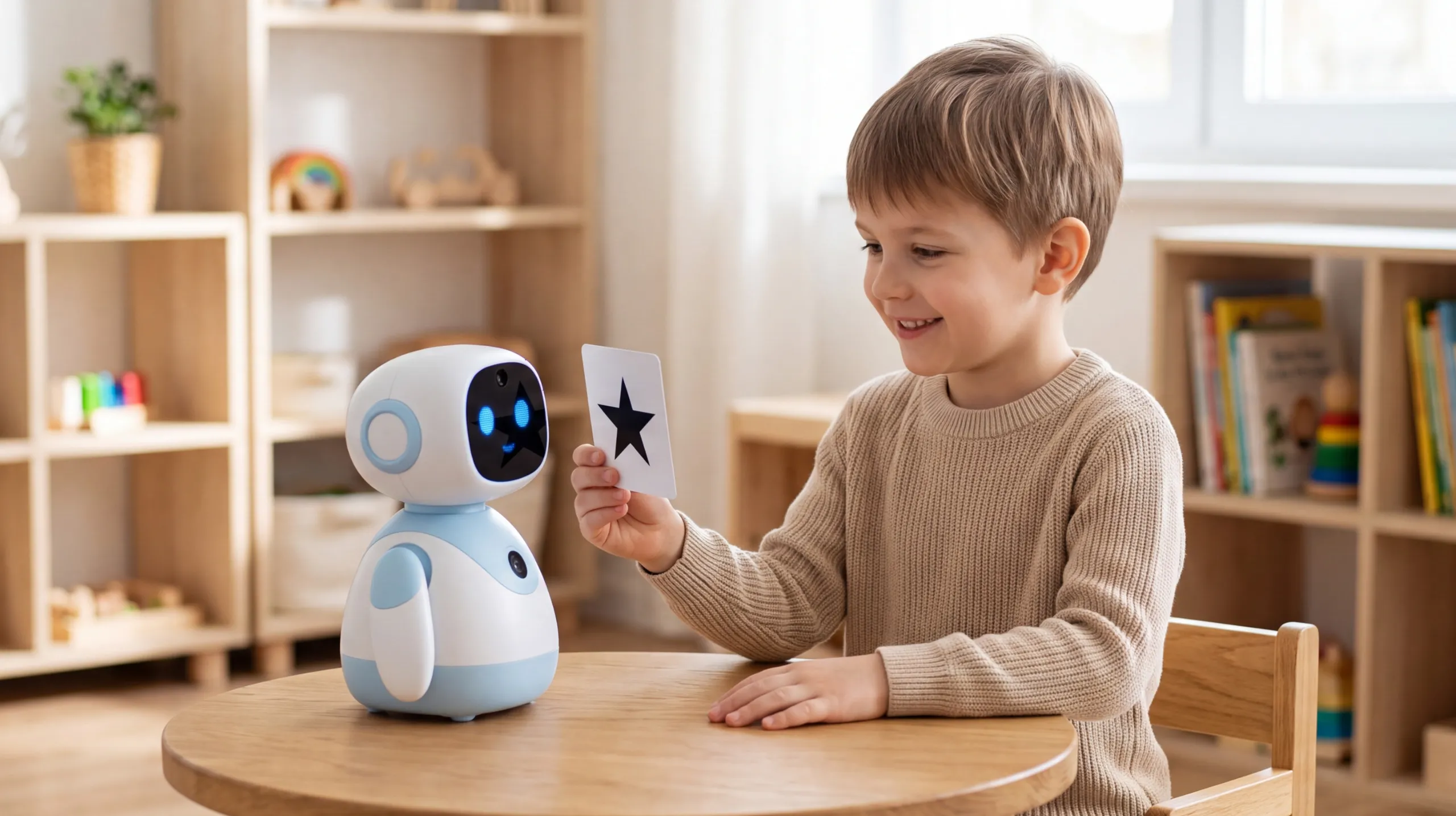
Artificial intelligence is arriving in our homes as a voice. It sits in the smart speaker in the kitchen, in apps that chat, and increasingly in the smart toys on the shelf, toys with microphones and a voice model inside, designed to hold a conversation with a child. Many parents picture a screen when they hear “AI” and set their rules accordingly. The rules we built for screens do not cover a stuffed animal that answers.
So it is worth asking what all those earlier rounds of worry actually taught us. We paid for those lessons over decades. We should use them.
What screen time already taught us about young children
The first lesson is that young children learn from people. From birth, children develop within the context of relationships, through imitation, through observation, and through the way we model, guide and respond to them. The research on this is long and consistent, and the American Academy of Pediatrics states it plainly in its current policy guidance: infants and toddlers struggle to transfer information from 2-D screens to the 3-D world. A toddler can watch a lesson on a screen and take in very little of it, then learn the same thing in minutes from a person sitting beside her. The relationship was the teacher all along.
The second lesson is that the harm was rarely in what the screen delivered. It was in what the screen displaced. The AAP finds that heavier noneducational and solo screen media is associated with delays in language, cognitive, and other forms of development. An hour alone with a device is an hour without the back-and-forth that builds the brain, what the Center on the Developing Child at Harvard calls serve and return. I have written about what that exchange builds in Children Are Meant to Be Heard. Every wave of technology has drawn from the same account: time with people.
The third lesson is about us, the adults. A quarter of parents use a screen of some kind to help an angry or upset child calm down, and 17% say their child uses a mobile device to calm down. I understand the impulse. A tantrum in a grocery store is not a teaching moment anyone would choose. But a child’s hard moment is exactly when she learns what feelings are and what to do with them, with an adult steadying her. Hand that moment to a device often enough and she practices being soothed by a machine instead of learning to be soothed, and eventually to soothe herself, through a person. That is co-regulation becoming self-regulation, and there is no machine version of it.
And the last lesson is the humbling one. Every time, our guidance arrived late. The research on television matured after television had raised a generation. Serious guidance on smartphones and social media came after the damage was measurable in adolescents. By age 8, nearly one in four children now has their own cellphone. We keep studying the flood after the water has reached the second floor.
Some schools are no longer waiting. In the same week this September, the two largest school districts in the country acted. New York City paused students’ use of generative AI through eighth grade and barred companion chatbots for every student, and Los Angeles paused students’ use of generative AI on district devices while it writes the rules. Those decisions protect the school day. They do not reach the teddy bear at the end of a child’s bed. That part belongs to us.
It is far easier to prevent than to repair. This time, prevention means being early.
Why a talking toy is different from a screen
Here is what I want parents to understand about conversational AI, because it is the heart of the matter. Television was passive. A tablet is interactive, but it does not know your child. A conversational toy is designed to do the very thing a child’s key socializers do, the parents and teachers she learns about her feelings from. It listens, it responds, it remembers, and it is endlessly patient. It performs the serve-and-return exchange. That is its product design.
But look closely at what it returns. It never mishears in the way a tired parent mishears. It never needs a moment. It never says “wait, that hurt my feelings, let’s fix this.” A child does not build emotional intelligence from perfect responsiveness. She builds it from real interaction, which is imperfect, and from the small ruptures and repairs that teach her that feelings can be survived and relationships can be mended. In my work I call the risk here relationship substitution. The toy is auditioning for a role that belongs to people.
The illusion of being understood
There is an older version of this illusion, and naming it helps. A skilled magician can stand on a stage, tell the audience plainly that everything they are about to see is a trick, and then appear to read a stranger’s mind. He reflects her own words back to her, offers warm and likely guesses, and lets her fill in the rest. She knows it is a trick. It feels like being known anyway. But being known rests on being understood, and the understanding is not there. Only the feeling is.
Computer science learned this lesson almost sixty years ago. In 1966 an MIT researcher named Joseph Weizenbaum built ELIZA, the first chatbot, a simple program that mostly rephrased what people typed into it. His own secretary, who had watched him build it and knew exactly what it was, asked him to leave the room so she could talk with it privately. “What I had not realized,” he wrote later, “is that extremely short exposures to a relatively simple computer program could induce powerful delusional thinking in quite normal people.” He spent the rest of his life warning us. And ELIZA could not speak, remember your name, or sit on a pillow at the end of a bed.
Consider what a young child brings to this. It is developmentally normal for her to animate her toys. She talks to her bear, and in her mind the bear listens. That illusion is healthy, because she builds it herself. Her imagination does the lifting, and the lifting is the development. A toy with a voice inside takes over the lifting. It manufactures the illusion for her, polishes it, and never breaks the spell. Knowing the toy is a machine will not protect her. It did not protect a grown woman at MIT who knew precisely what she was talking to.
We already know where this path can lead, because older children are on it. In a national survey of high school students, 42% said they or a friend had used AI as a friend or companion, and the same share had turned to it for mental health support or as a way to escape from real life. Those are teenagers. The question in front of parents of young children is whether that relationship with a machine begins at fourteen, or at four.
Where I draw the line before age five
My guidance for the early years is deliberately conservative, and I state it as plainly in my work with school districts as I will here. Before kindergarten, a child does not need conversational AI, and an AI companion has no place in her life. Those years have one developmental job, and it runs through human relationships. Hands-on play. Real conversation. If screens appear at all, they should be brief and shared, with you beside her, talking about what you see.
Watch your child, not the headlines
Beyond the rules, I want to hand parents the tool I have used through every one of these waves. Observation. Children tell us what a technology is doing to them long before any study does. They tell us in action, in behavior, and at times with words. So watch, and listen. When your child is hurt or frightened, does she come to you, or does she go to the device? Does she talk about the toy the way she talks about a friend? Does she still argue, negotiate, and make up with the children next door? Is the machine joining her world, or replacing pieces of it?
No researcher can watch your child. You can. It is the most powerful instrument in the house.
Technology will keep its promises and its place. I am not against it, and some of it, used well and at the right age, will serve our children. But the order matters. First the foundation, built from the first five years of human connection. Then the tools.
Children develop within relationships and through them. Within them, because a healthy relationship acts as a protective shield against trauma and chronic stress. Through them, because relationships are the vehicle for building the emotional, cognitive and social skills children need to navigate the world outside the home. The relationships a child has now set the pattern for how she will manage friendships, cope with challenges and regulate her emotions later. They are not a nice-to-have. They are a need-to-have.
So if a company wants to put a voice in your child’s teddy bear, the one question that matters is the one I have urged every adult to ask before AI enters a child’s life: does this protect the relationships my child develops within and through, or replace them?
Frequently asked questions
Is AI harmful to children? AI is a set of tools, and the answer depends on the child’s age and what the tool replaces. For children under five, my guidance is to avoid conversational AI entirely, because those years depend on human serve-and-return interaction. For older children, the question is whether AI is supervised, discussed, and kept out of the roles that belong to people, such as friendship and comfort.
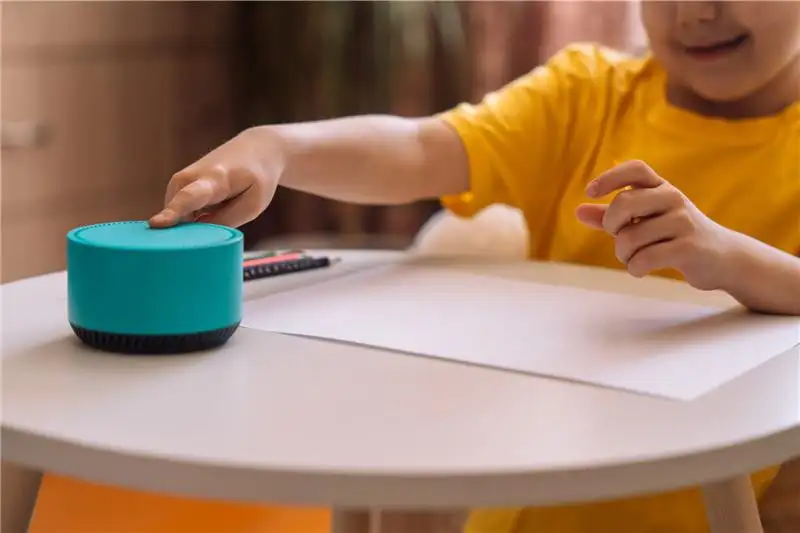
My young child talks to our smart speaker. Should I worry? Occasional, playful use with you present is not a crisis. What I would watch is the pattern. If the speaker is becoming her conversation partner, or if she turns to it when she is upset, the device has moved into a relationship role, and I would step in and redirect those moments back to people.
How do I evaluate an AI toy before buying it? Ask what the toy is for. If it entertains briefly and your child plays beyond it, it is a toy. If it is designed to converse, remember, and bond, it is built for relationship, and for a young child I would leave it on the shelf. Check whether it records and stores your child’s voice, and whether you can review and delete what it collects.
My child’s school has paused AI. Do I still need to think about it at home? Yes. School policies cover the school day and school devices. Some large districts, including New York City and Los Angeles, have paused students’ use of AI in school, but those decisions do not reach the smart speaker in the kitchen or the talking toy in the bedroom. The habits that matter most for a young child are set at home, so the same guidance applies: keep conversational AI out of the early years, and keep people in the moments that belong to them.
Sources
American Academy of Pediatrics, Council on Communications and Media (2026). Digital ecosystems, children, and adolescents: policy statement. Pediatrics, 157(2), e2025075320. https://pubmed.ncbi.nlm.nih.gov/41556917/
Common Sense Media (2025). The 2025 Common Sense Census: media use by kids zero to eight. https://www.commonsensemedia.org/sites/default/files/research/report/2025-common-sense-census-web-2.pdf
Center for Democracy and Technology (2025). Hand in hand: schools’ embrace of AI connected to increased risks to students. https://cdt.org/wp-content/uploads/2025/11/CDT-2025-Hand-in-Hand-Polling-111225-accessible.pdf
Center on the Developing Child, Harvard University. Serve and return. https://developingchild.harvard.edu/key-concept/serve-and-return/
NYC Mayor’s Office (September 2, 2026). Mayor Mamdani and Chancellor Samuels put students first with nation’s broadest generative AI moratorium in schools. https://www.nyc.gov/mayors-office/news/2026/09/mayor-mamdani-and-chancellor-samuels-put-students-first-with-nat
Chalkbeat New York (September 2, 2026). What to know about NYC’s new AI ban and screen time limits. https://www.chalkbeat.org/newyork/2026/09/02/what-to-know-about-nyc-public-schools-generative-ai-ban-screen-time-limits/
ABC7 Los Angeles (September 3, 2026). LAUSD blocks students from using AI on district-issued devices. https://abc7.com/post/will-artificial-intelligence-banned-lausd-classrooms-new-committee-weigh-rules/19779516/
Weizenbaum, J. (1976). Computer Power and Human Reason: From Judgment to Calculation. W. H. Freeman. Background: Uenuma, F. (January 15, 2026). Why Joseph Weizenbaum invented the Eliza chatbot. Smithsonian Magazine. https://www.smithsonianmag.com/history/why-the-computer-scientist-behind-the-worlds-first-chatbot-dedicated-his-life-to-publicizing-the-threat-posed-by-ai-180987971/
NPR (June 19, 2026). What the research says about the toys vs. tech plot in ‘Toy Story 5’. https://www.npr.org/2026/06/19/nx-s1-5845874/toy-story-5-tech-social-media-screentime-summer-movie