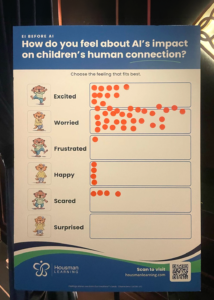
 On a Wednesday evening in late October, as our guests arrived in Boston for EI Before AI, each of them placed a dot on a board beside the feeling that came up when they thought about AI and our children. Most of the dots were under worried, the second most were under excited, and a great many sat somewhere between the two, placed by people who were feeling both at once.
First, I want to validate both of those feelings. If you lead a school or a district and you are carrying both, that makes sense to me. At the close of the panel I asked whether anyone’s feeling had changed, or even just its intensity, and a few hands went up. Since then, a superintendent has told us that his feeling has moved from worried to a sense of urgency.
When Dr. Michael Conner, who moderated our panel, asked each of us for one call to action, mine was to invest in the educator, because the teacher is the curriculum, and the teacher is the person who needs the support, the preparation and the training to help children develop critical emotional competencies. When you invest in the teacher, you are investing in the child, the classroom and the school.
Why I begin with the teacher
Emotional intelligence is a capacity, and it is developed through co-regulation with an attuned adult, one who is empathic and responsive to the needs of the child. In research I published in 2017, I described co-regulation as the process in which caregiving adults “facilitate a child’s ability to understand, express, and modulate their thoughts, behaviors, and feelings through support, coaching, and modeling in warm, responsive interactions,” and self-regulation as an outgrowth of it. In a classroom, this means that a young child learns to manage a big emotion with and by the adult beside them. And given that children develop within the context of relationships and learn through observation, imitation, modeling, guidance and how the adult responds to them, the adult’s own ability to notice what they are feeling, to stay regulated, and to respond appropriately to the child is what that child learns from.
An emotionally dysregulated child cannot learn, and an emotionally dysregulated adult cannot effectively teach. Yet among the staff at the pilot schools in our 2024 white paper, seven in ten had received some training that addressed promoting children’s well-being, and very few had received any training about their own emotionality. Teachers’ plates are bubbling over, and most are doing this work without that preparation or support.
What investing in the educator takes
Coaching is what changes what an adult does in a hard moment with a child. A 2026 meta-analysis of 112 studies of coaching for early childhood teachers found positive, medium-to-large effects on both teacher practice and child outcomes. The begin to ECSEL™ program was designed around coaching, out of daily practice at the school I founded in 1985. Educators move from understanding their own emotionality to responding to children in real time in the classroom, with coaching being an integral part of the process along the way, and the full program typically runs a few years with positive outcomes starting to be seen in only a few months’ time.
In the fall of 2023, twenty-two schools and centers across fourteen states took part in a pilot of the program that lasted a few months. Afterward, 86 percent of them reported that their staff were better able to regulate and manage their own emotions, and 86 percent reported improved emotion regulation in their young learners. At one Boston early learning provider, two years into the work, 91 percent of teachers reported that they were able to reflect on their own triggers and emotional reactions and find more beneficial strategies with children. Those figures are the schools and the teachers’ own reports. In our peer-reviewed research published in 2022, we measured the children directly, and about six months period they showed significantly outperformed a matched comparison group in self-regulation, executive functioning and learning.
Where AI comes in
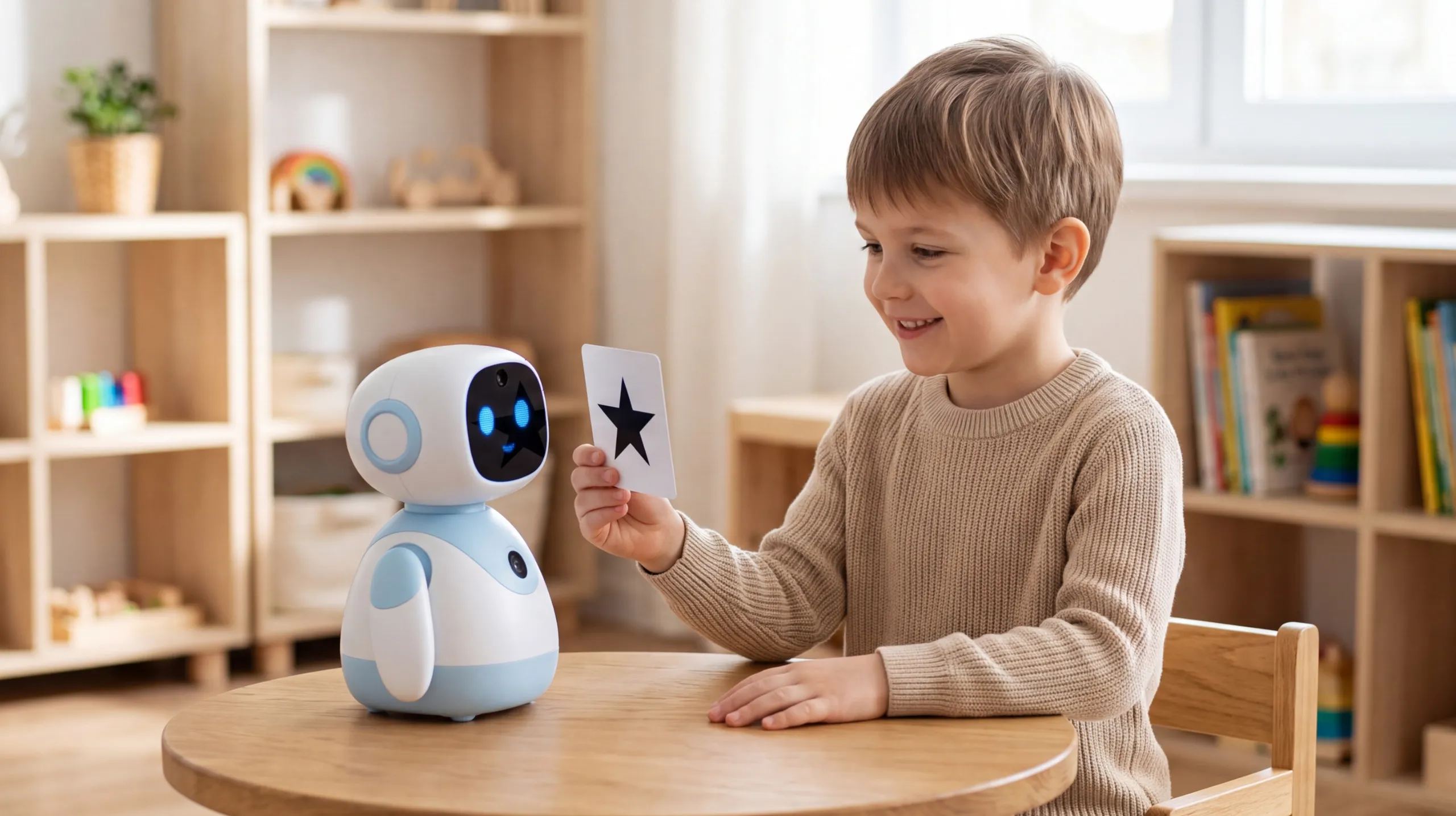
I see many opportunities for AI in schools, and I said so in Boston. The work that AI can take from a teacher’s plate can give that teacher more time with children, and what motivates a child to learn is feeling known and understood by the people around them. When emotional intelligence is built into a school, it also helps the people there make better decisions about technology. Before any AI decision, I would ask every district one question. Will this increase or decrease the quality of human interaction in your schools?
Where a leader might begin
If you lead a school or a district, I would begin with two questions about your own buildings. What training do adults who teach your youngest children have about their own emotionality, as well as the support in understanding how to help the children manage their own emotions and be empathic to the emotions of others? Who coaches them in the moments that are hardest, and for how long?
You do not have to settle everything about AI before you begin, and you are not going to get every decision right, and that is okay. What we build in a child’s earliest years, through the adults who are with them every day, gives children rooted, foundational capacities first, and then the wings to take off and become their best selves. Thank you to everyone who joined us in Boston. If your feeling has shifted since that evening, in either direction, I would so love to hear about it.