Reflective Practice is Housman Institute’s adaptation of Reflective Supervision. It is a process that focuses on self-reflection of one’s experiences, interactions, feelings, reactions, and areas of growth to promote emotional awareness, critical thinking, and problem-solving. Reflective Practice creates an environment that promotes self-reflection, empathy, understanding, support, and both personal and professional growth.
This comprehensive overview of Reflective Practice includes its definition, what it looks like day to day in childcare, its benefits, the six steps, weekly and critical reflection examples, strategies, and implementation tips.
Table of Contents
- What is Reflective Practice?
- Importance in Early Childhood Education
- Reflective Practice in Childcare: What It Looks Like Day to Day
- The Benefits of Reflective Practice
- Reflective Practice Steps
- Weekly Reflection Examples
- Reflective Practice Strategies
- Integrating Reflective Practice into Professional Development
- The Role of Reflective Practice in Child-Centered Education
- Reflective Practice Resources
- Key Takeaways
What is Reflective Practice?
Defining Reflective Practice
Reflective Practice is Housman Institute’s adaptation of Reflective Supervision. It is a process that focuses on promoting self-reflection, emotional awareness, critical thinking, and problem-solving to identify areas of growth, find more beneficial strategies, come to one’s own conclusion about a challenging experience, and meet professional goals. Reflective Practice creates an environment with reflection, empathy, understanding, support, and personal and professional growth at the center.
Who Is Involved?
Reflective Supervision typically occurs in structured sessions between a trusted mentor, coach, or supervisor and a mentee, but the Reflective Practice process can also take place between any members of the community. This includes Directors, Principals, Mentors, Coaches, Lead Teachers, Teachers, Teaching Assistants, SLP, Counselors, children, and families. While more structured Reflective Practice sessions between a mentor and mentee should take place one-on-one in a safe environment, it can also take place less formally between other members of the community.
To find out more about how this may look, see The Power of Reflective Practice blog series:
Importance in Early Childhood Education
Reflective Practice plays a vital role in early childhood settings. It provides continuous professional development, support, and feedback for all members involved and gives staff a safe space to discuss challenging experiences and related feelings. It lays the groundwork for ongoing professional development through consistent self-reflection, community support, and emotional awareness.
Reflective Practice allows individuals to become more aware of their emotional triggers and learn how to effectively manage them with guidance from a trusted mentor. Children are emotional detectives who pick up on everything, including the verbal and non-verbal responses and reactions of the important adults in their world.
If we as children’s trusted caregivers do not have awareness of our own emotions, the skills to understand and manage them, or a means to actively practice self-reflection, we are unable to support children’s development of these same skills. Additionally, being an early childhood educator, while rewarding, comes with a great deal of stress. It’s critical that educators are able to manage the feelings that come with stress in order to support children’s development, communicate effectively with co-workers and families, and find job satisfaction.
Reflective Practice in Childcare: What It Looks Like Day to Day
In childcare, Reflective Practice means making regular time to look back at real moments with children, families, and coworkers, notice how we felt and how we responded, and decide what we will do differently next time. It happens in scheduled sessions with a trusted mentor, and it also happens informally throughout the day: between teachers who share a room, between a director and a teacher, and between educators and families.
Childcare days are full and fast. Between arrivals, meals, naps, play, and pickups, there is rarely a quiet moment to think, which is exactly why reflection needs a place in the routine.
Here is what Reflective Practice can look like across a typical day in a childcare center:
- At arrival. Before the first family walks in, take a moment to check in with yourself. Noticing and naming how you feel, such as “I am feeling rushed this morning,” helps you begin to manage it.
- In the heat of the moment. When an infant cries through a goodbye, a toddler grabs a toy, or a preschooler throws blocks, take a deep breath before you respond. That pause gives you room to model the calm you want children to learn.
- During nap or planning time. Write down a few lines about one moment that stayed with you: what happened, how you felt, and what you might try next. Writing it down validates that something affected you and lets you return to it out of the heat of the moment.
- At the end of the day. Spend a few minutes with your teaching team talking through what went well and what didn’t, so everyone is on the same page for tomorrow. Reflecting together as a team builds trust between the adults in the room.
- Once a week, with a mentor. Bring one challenging experience to a scheduled session and walk through the six steps below together. Weekly Reflective Practice sessions build the trust and consistency that make honest reflection possible.
What you reflect on will shift with the ages in your care. In an infant room, reflection may center on caregiving routines and how calm and responsive we are during them, because emotion is a baby’s first language and babies learn about feelings from us. In a toddler room, it may center on big feelings around independence, waiting, and sharing. In a preschool room, it may center on transitions, friendships, and conflicts between children. In begin to ECSEL classrooms, tools such as Our Emotions Cards (for infants and up) and Our Emotions Board (for toddlers and up) give children and teachers a shared language for these moments. At every age, the process stays the same: notice, reflect, and plan.
The Benefits of Reflective Practice

Enhancing Self-Awareness
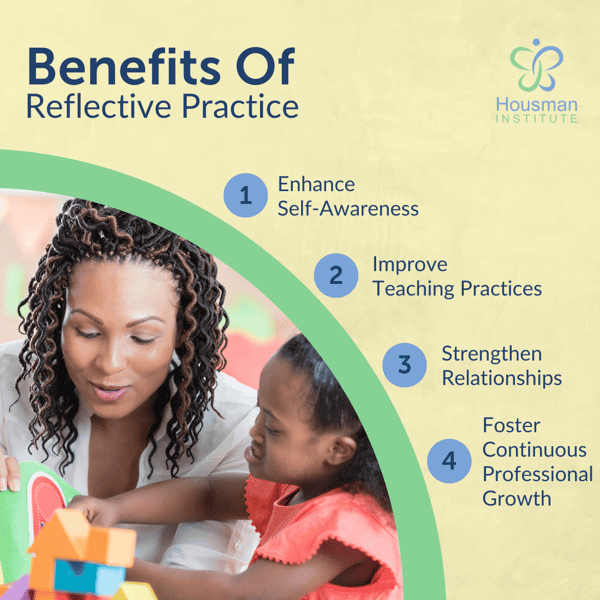
Consistent self-reflection paves the way for emotional awareness and self-awareness. Whether it’s reflecting on children’s needs, the different communication preferences of families, or how you reacted in a disagreement with a co-worker, being aware of your tone of voice, facial expressions, body language, feelings, and reactions ensures that you are able to take a step back, manage your feelings in the heat of the moment, adjust your approach, and respond appropriately. Reflective Practice encourages early childhood educators to develop a deeper understanding of their own beliefs, biases, and values. By examining one’s own assumptions and reflecting on one’s actions and interactions, educators become better equipped to respond to the diverse needs of children, families, and co-workers.
Improving Teaching Practices
Through reflection, educators can identify strengths and areas of growth that help improve their teaching practices. When we are able to take a step back and realize, “this isn’t working,” we end up giving ourselves space to consider what could work better. Whether it’s how we engage with children, how we support their emotions and behaviors, how we plan curriculum activities, how we communicate with families, or how we collaborate with co-workers, Reflective Practice allows us to refine our approach to better support children’s individual and developmental needs.
Strengthening Communication and Relationships
Reflective Practice helps educators use empathy and perspective-taking with others – reflecting not just on how we feel, but how others might feel as well to actively improve communication. It helps promote authentic relationships with children and families, and with co-workers. Tuning into the emotional responses of others helps us act with compassion and empathy during challenging conversations, creating respectful partnerships rather than confrontations.
Fostering Continuous Professional Growth
Reflective Practice allows all educators to truly tap into their best selves personally and professionally, which strengthens the entire early childhood education community. Through continuous reflection, educators are able to enhance their emotionality, understand their reactions to stress, find better stress-management techniques, explore their communication and interactions with others, and identify their goals and areas of improvement. Through proactive problem-solving, educators expand their knowledge and skills, and find strategies to help them meet their goals. Reflective Practice ensures that all members in the community get the opportunity to explore how their work, role, actions, and words impact others – and how they, in turn, are impacted by their work.
Reflective Practice Steps:
Reflective Practice sessions have six key steps that follow the Gibbs Reflective Cycle. During sessions, mentors support mentees in self-reflection by asking open-ended questions to prompt critical thinking, and actively listening to mentees’ responses. The Reflective Practice steps can also be applied during daily routines with children, co-workers, families, or other members of the community.
Step 1: Description
The mentor prompts the mentee to describe a challenging experience or interaction by asking, “What happened?” and participating in active listening. This gives the mentee a safe space to reflect on the experience and describe the details of what happened in their own words.
Step 2: Feelings
The mentor prompts the mentee to connect the challenging experience to their feelings by asking, “What did that make you feel?” and continuing to actively listen. Connecting emotions to a cause not only helps mentees better understand their feelings but can also help bring light to any emotional triggers, which mentors can then support with managing and navigating.
Step 3: Evaluation
The mentor guides the mentee to evaluate how the experience went by asking, “What went well? What didn’t? How did you contribute?” This is an important step, as it takes any judgment away from what happened and allows the mentee to examine their experience through a critical and empathetic lens. It also helps mentees explore how they contributed to an experience, both positively and negatively.
Step 4: Analysis
The mentor supports the mentee in understanding the meaning of the experience by asking, “Why do you think that went well? Why do you think that didn’t go as well?” and actively listening before providing their own insight. This step helps mentees explore why their contributions to certain parts of the challenging experience were successful or not, paving the way towards problem-solving and brainstorming more beneficial strategies.
Step 5: Conclusion
The mentor supports the mentee in coming to a conclusion about the challenging experience based on their reflections by asking, “What could you have done differently?” This step helps mentees think critically and come to their own conclusion about what could have made the challenging experience more successful.
Step 6: Action Plan
The mentor guides the mentee to think about what they would do differently by asking, “What will you do differently if a similar situation arises in the future? What support do you need to accomplish this?” This important final step ensures that mentees are able to follow through with their plan accountability and support.
Weekly Reflection Examples
A weekly reflection is a short written look back at one or two moments from your week. It does not need to be long or polished. What matters is writing regularly, so you can notice patterns in your feelings, reactions, and strategies over time and bring what you notice to your Reflective Practice session.
You can use the questions from the six steps above as your journal prompts:
- What happened?
- What did it make me feel?
- What went well? What didn’t? How did I contribute?
- Why do I think it went that way?
- What could I have done differently?
- What will I do differently next time, and what support do I need?
The examples below are illustrative, written to show what a weekly reflection can look like in infant, toddler, and preschool rooms. Each one is written as a teacher’s own journal entry. The children and teachers in them are not real, but the moments will likely feel familiar.
Example 1: Infant room, a hard goodbye
“One of our babies cried hard every morning this week after her family left. On Tuesday I was holding her while warming bottles and answering a question from another parent, and I noticed my voice getting quick and tight. I felt rushed and a little helpless. What went well: I kept her close and told her, ‘You feel sad. You miss Mama.’ What didn’t: I was trying to do three things at once, and I think she felt my hurry.”
What I learned and will try next: Even the youngest children pick up on our tone of voice and body language. Next week I will ask my teaching partner to cover bottles for the first ten minutes after arrival so I can slow down, breathe, and stay with her. At pickup, I will tell her family how she settled.
Example 2: Toddler room, spilled water at snack
“At snack on Wednesday, a toddler insisted on pouring her own water and spilled it across the table for the third time. I said ‘Oh no, not again!’ louder than I meant to. She cried and pushed her cup away. I felt frustrated, then guilty. What went well: I helped her clean up calmly afterward. What didn’t: my first reaction was about the mess, not about her. I was already tired from a morning of grabbing and tears.”
What I learned and will try next: Spills are part of how toddlers build independence and mastery, and children copy our reactions. Next week I will take a deep breath before I respond to a spill, offer a smaller pitcher, and say, “It’s okay, accidents happen. Let’s clean it up together.”
Example 3: Preschool room, a cleanup that fell apart
“Cleanup on Thursday fell apart. I turned off the lights with no warning, and the other two teachers looked as surprised as the children. Children ran between centers, one threw blocks, and I raised my voice across the room. I felt embarrassed and annoyed with everyone, including myself. What went well: once we sat down for circle, the class settled quickly. What didn’t: none of the teachers were ready for the transition, so the children weren’t either.”
What I learned and will try next: If the adults aren’t prepared for a change, the children won’t be. Next week our team will give the whole room a warning two minutes before cleanup, and each of us will take one area of the classroom and clean up alongside the children, narrating what we are doing.
Example 4: Preschool room, a hard conversation at pickup
“A father asked me at pickup why his son keeps coming home upset about friends. I felt defensive right away and started listing everything we already do. He left looking unhappy. What went well: I stayed calm and offered to talk again. What didn’t: I talked more than I listened, and I never asked what he sees at home.”
What I learned and will try next: My defensiveness came from worrying that he thought I wasn’t doing my job. Next time I will listen first, ask, “What have you noticed at home?”, and share one thing his son is working on and one thing that is going well. I will bring this conversation to my mentor this week.
Example 5: Any room, looking at my own week
“By Thursday afternoon I was short with everyone, children and coworkers alike. Looking back, I skipped my break on Monday and Tuesday and never said out loud that I was overwhelmed. I felt tired, then irritable, then guilty for being irritable. What went well: on Friday I asked my teaching partner to step in for five minutes, and I came back calmer. What didn’t: I waited until I was already at my limit.”
What I learned and will try next: When I push my feelings down, they come out later as impatience. Next week I will take my breaks, check in with my own feelings at nap time, and tell my teaching partner sooner when I need a moment.
Notice how each entry moves from what happened, to feelings, to what went well and what didn’t, to a specific plan. Over a few weeks, your entries will start to show patterns, such as the times of day that are hardest for you or the strategies that work best. Those patterns are exactly what to bring to your next Reflective Practice session.
Critical Reflection Examples
Critical reflection goes one step further. Instead of only asking what happened, we question the beliefs, assumptions, and habits behind our responses. We all carry emotional fingerprints from our own early experiences, and they shape how we react to children and adults today. Here are three illustrative examples, written as a teacher’s journal notes, of what that questioning can sound like.
Questioning a label
“I caught myself telling a colleague that one boy is ‘always the one who starts it.’ When I read my notes from the week, I had written down every time he pushed, but none of the times he waited for a turn or helped a friend. Was I watching him more closely than the other children because I expected trouble?”
Next step: I will record his helpful moments too, and ask my mentor to observe our room with fresh eyes.
Questioning which feelings are “allowed”
“I noticed that I praise children for being happy but hurry them past anger and sadness with ‘You’re okay, you’re fine.’ Where did I learn that some feelings are good and others are bad? In my family, anger was something you kept to yourself.”
Next step: I will name and welcome every feeling first, then help the child find what to do with it. All emotions are okay; it’s what we do with them that matters.
Questioning an assumption about a family
“I assumed one family didn’t care about school because they never answered our notes home. When I finally asked at pickup, I learned that they prefer a quick text and that the father works evenings. My assumption said more about my expectations than about them.”
Next step: I will ask every family how they would like to hear from us.
Critical reflection can feel uncomfortable at first. That is normal, and it is easier with a trusted mentor who listens without judgment. If you lead a team, our Reflective Practice for School Leaders course helps you guide reflective sessions like these in your school. And remember, Reflective Practice takes practice: give yourself the same patience you give the children in your care.
Reflective Practice Strategies
Creating a Supportive Culture

Establishing a supportive culture within Reflective Practice settings is key to successful implementation. Leaders, administrators, and mentors play a pivotal role in fostering an environment that encourages open dialogue, respectful communication, diverse perspectives, and values continuous improvement.
Observations and Documentation
Regular classroom observations can help mentors gain valuable insight into what teachers discuss during Reflective Practice sessions. Documenting observations and taking notes during and after sessions helps mentors follow up with action plans. It also helps mentors keep track of what different solutions have been implemented, allowing for adjustment and continued problem-solving.
Establishing Regular Reflective Opportunities
Within Reflective Practice relationships, trust and consistency are key. Put a schedule in place for observations, regularly scheduled Reflective Practice sessions, and follow up. This helps mentors gain insight into what is happening in classrooms in order to provide the appropriate support. Not every solution is found right away! Regular Reflective Practice sessions create an environment where all individuals gain confidence in the act of self-reflecting, and the relationship becomes one of trust where individuals feel comfortable speaking openly and freely in mutual pursuit of a solution. It also helps staff feel reassured that they have a dedicated time to address challenges and seek support from their trusted mentor.
Active Listening Without Judgment
Opening up and revealing one’s challenges and emotions can make us feel vulnerable. This makes the mentor’s job all the more valuable and important. Not all sessions will feel positive and uplifting. Reflective Practice can bring up difficult conversations, such as concerns about a child’s behavior, uncomfortable interactions with parents or co-workers, and stressful situations. Mentors need to be active and thoughtful listeners who are understanding, accepting, and non-judgmental. Creating and maintaining an open and honest relationship is key to Reflective Practice. When this partnership is established and worked on, all members gain comfort in speaking openly without fear of judgment.
Adjusting Your Approach
It is important for mentors to be aware of how mentees prefer to communicate, take in new information, respond, react, and problem-solve so you can adjust your approach, language, tone, and techniques to provide the best level of support. Reflective Practice requires using open-ended questions and statements to prompt self-reflection, but for some this may mean providing more context, guidance, and modeling. Adjust your approach to help scaffold the reflection process by using more specific questions or bringing up observations in a sensitive way. This ensures that all individual needs are met in order to see beneficial outcomes.
Engaging in Collaborative Reflection
Reflective Practice doesn’t just need to take place one-on-one! It can also be the perfect setting for co-teachers or coworkers to reflect together. Collaborative reflection involves coming together to discuss and analyze their teaching practices, discuss challenges, share ideas and solutions, and engage in team-reflection.
Providing Professional Development and Training
Offering professional development opportunities and training focused on Reflective Practice equips early childhood educators with the necessary knowledge and skills to effectively implement the process and see benefits community-wide. Providing guidance on different reflective strategies and offering resources helps enhance educators’ ability to engage in Reflective Practice.
Integrating Reflective Practice into Professional Development
Incorporating Reflective Practice into Training Programs
Reflective Practice should be integrated into early childhood education training programs, especially those focused on mental health, well-being, and emotional development. When training programs place self-reflection, self-awareness, communication, problem-solving, and professional growth at the center, educators are set up for support and success.
Mentoring and Coaching
When Reflective Practice is incorporated into programs with mentoring and coaching, it provides valuable support for educators. Experienced mentors and coaches can guide and support teachers through the Reflective Practice process, offering feedback, encouragement, and guidance for professional growth.
Networking and Collaboration
Engaging in professional networks, online communities, or attending conferences based in Reflective Practice and collaboration can expand educators’ perspectives and expose them to different approaches to Reflective Practice. Collaborating with colleagues from different settings and backgrounds encourages the exchange of experiences, ideas, and opinions, which can help provide insight and strategies that can be implemented into your teaching practices.
Related: Learn more about the begin to ECSEL Professional Development Program
The Role of Reflective Practice in Child-Centered Education
Individualizing Instruction

Reflective Practice helps educators tailor their teaching approach to meet each child’s individual needs and interests. By working to enhance one’s own emotionality, learn stress-management strategies, and find solutions from self-reflecting, educators become more self-aware and more attuned to children. This allows educators to observe the responses of children and reflect on their needs, helping with making informed decisions about adjusting teaching, materials, and learning experiences to optimize learning outcomes for all children.
Going Beyond Just Positive Behavior Guidance
Reflective Practice can also help educators find effective ways to manage children’s behaviors and support their understanding of emotions, what caused them, and related behaviors. By analyzing challenging situations, educators can explore the underlying factors and identify proactive strategies to support children’s emotional intelligence. By using Reflective Practice strategies in developmentally appropriate ways, educators can support children in explaining why a behavior isn’t okay before providing an example of something that they can do instead. This helps children understand the impact of their behaviors on others, constructively express their emotions, and gain confidence with the knowledge that all emotions are okay, but it’s what we do with them that matters most.
Supporting Emotional Intelligence Development
Reflective Practice helps educators develop critical emotional competencies themselves first so they can foster these same skills in children – the skills of emotional intelligence. By self-reflecting, educators learn how to practice effective emotional identification, understanding, expression, and regulation in order to model for and guide children in these strategies. Reflecting on one’s own interactions, responses, and reactions to challenging classroom experiences also helps educators adjust their approach to model empathy, prosocial behaviors, inclusion, self-regulation, communication, and relationship skills that children internalize and make their own. This promotes children’s healthy emotional intelligence development, mental health, well-being, and learning.
Promoting Problem-Solving and Executive Function Skills
The dysregulated brain cannot learn. When children (and adults) are dealing with an unmanaged emotion, it hijacks the brain’s ability to listen, think, focus, learn new information – key executive function skills necessary for learning. Through regular implementation of Reflective Practice and Emotional, Cognitive, and Social Early Learning (ECSEL) language, tools, and techniques, children between the ages of 0-8 learn to manage their emotions so they can learn, succeed, and thrive emotionally, cognitively, and socially.
Reflective Practice Resources
Books, Journals, and Research Articles
Books, journals, and research articles provide valuable information about Reflective Practice and its connection to emotional intelligence and Emotional, Cognitive, and Social Early Learning (ECSEL).
Online Communities and Forums:
Online communities and forums dedicated to early childhood education help educators connect, share their experiences, collaborate, and engage in reflective conversations. Platforms such as social media groups, blogs, and discussion forums connect educators worldwide. In Housman Institute’s flagship begin to ECSEL Educator Training Program, all staff enrolled are invited to an online community focused on promoting self-reflection, Reflective Practice, and emotional intelligence.
Professional Organizations and Conferences:
Joining professional organizations and attending conferences or webinars focused on Reflective Practice connects early childhood educators to resources, workshops, and networking with others pursuing a mutual goal. Learn more about upcoming learning opportunities here.
Key Takeaways
Reflective Practice is a powerful approach that empowers early childhood educators to continuously improve their teaching practices and meet their personal and professional goals. By engaging in self-reflection, educators develop a deeper understanding of their own feelings, beliefs, values, and biases, leading to increased self-awareness, emotional intelligence, job satisfaction, and well-being. Implementing Reflective Practice in early childhood settings creates a culture of collaboration and continuous improvement, contributing to high-quality learning experiences for children and positive outcomes for the entire community.

About the Main Contributor: Emily Stone‘s experience with begin to ECSEL started at Housman Institute’s lab school where she was a preschool and pre-k teacher. During her time teaching, Emily underwent extensive ECSEL training and specialized in developing curricula with children’s emotional intelligence at the heart of each lesson. Soon after, she became the Program Manager, where she used Reflective Practice to train and support teachers in their curriculum development and use of ECSEL language, tools, and techniques. Currently, Emily is the Manager of Curriculum and Coaching, where she oversees all written content for Housman Institute’s programs, supervises the live implementation of the begin to ECSEL Educator Training Program in schools, and coaches school directors and administrators enrolled in the program.